endemismotrasnochado

Spanning the globe with frequent and once in a while readers. I am interested in collecting, propagating plants, landscape management practices, ecology, environment, flora/fauna, in essence Nature. This blog is written in a blunt, abrasive fashion with consistent critical views on these subjects and others that may be related...or not.

martes, 19 de enero de 2010

CARDINAL MOVES AND EXCERPT BONUS

AFTER SEVEN days with rain, the sun is back.. I can not imagine what a trip would be to have such a wet season for six months in a row, as it happens in other places.

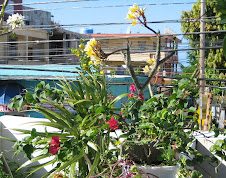
Two pink Frangipanis propagated from seed went from the east side to the old cement round pots, a present from Don Miguel, in the north. Both trees are about a year old, measuring about two feet. They flank the handsome Dracaena in front of our decorative garage, since we prefer to park in across the street in front of the house.

The Ochna mossabicensis and Bauhinia tomentosa former residents, are now in the south side with a Bauhinia blakeana and Bixa orellana as new
garden mates. Some dwarf Ruellias were planted not far on the ground,
after the final eviction of the Wedelias and Bejucos, pain in the ass. A few
Wedelias are left in other areas but they are not a priority now. The compost pile was aerated and shredded newspapers added to increase volume and reduce humidity. Earthworms love them.

Another day, another rain. The sky looks pretty much as those autumn
days in the northeast of USA, Northampton comes to mind...At any rate,
I found a couple of paragraphs in a book mentioned recently.

THE BROTHER GARDENERS
Amy Wulf

In many ways, Thorndon was the first garden in which Enlightenment thinking found its visual expression. It was, as Collinson wrote, a garden based on "Hints Borrowed from Nature."
For centuries , high walls had excluded untamed nature from the garden, providing protection from the landscape beyond. Now, with the Enlightenment and man's growing knowledge of the natural world, gardeners embraced the idea of letting nature reign. Petre had planted his trees
and shrubs in such a way as to allow the visitor to think of them not as an object of singular delight but as an integral part of a larger landscape. He had followed Miller's advice that his plants should "appear accidental as in a natural Wood," and grow like "Spontaneous acts of
Nature." Clumps in the lawn like those at Thorndon created drifts of dense growth on the smooth grass, unlike the complex patterns of baroque gardens, which were better enjoyed from the windows of the first or second floor. Thorndon could only be appreciated by walking along its meandering gravel paths.

Petre had carefully tiered the trees and shrubs that lined these paths so that they rose in height, almost like seats in a theatre, the smallest flowers at the front, the largest trees at the rear. And
whereas, in the past gardens had been experiences just for the eyes, now they were for all senses.
Some of the flowers come so close to the path that the hooped petticoats of the women visitors brushed against them, releasing the fragrant scents of the blossom. And instead of motion less
rigid hedges that used to enclose parts of the garden like "Prison Walls," here at Thorndon the leaves dance to the maraca rhythm of the wind. Pages 93/94

IN Puerco Rico USA, these simple, ancient principles are IGNORED. The landscape architects/agronomist jerks are still in the DARK AGES. I have been wondering what is the great difficulty to understand this rule. A garden should look natural. Feel natural, appealing to all senses. I am sure in your country, many gardens have that stiff, with abundant overkill trimming/pruning also.

In endemismo I have mentioned a hundred times the ridiculous, absurd
garden installations all over the island, in public/private contexts. Costly to install and a pain in the ass to maintain. With these excerpts there should be no doubts. I did not pull the principle out of my sleeve. It seems that it has been there to be studied for two hundred years.

A few last words. I used to love the essence of the ZEN/Japanese/Chinese garden, however, it is exactly the contrary of what I practice/preach nowadays. From this gardening school I still enjoy those elements found in those rectangles with walls, with just white gravel/sand, raked in classical designs, rocks/stones placed accordingly and a few not stiff bushes in the classical/standard impair groupings, in total quiet to meditate or hang out. Time to go...


sábado, 16 de enero de 2010

TOOLS FOR THE MASTER GARDENER

IF YOU ARE NOT, into tools, may not know names, please check: amleonard.com or gempers.com for illustrations. I tell you one thing, if you buy anything for the first, be willing to pay the same
price for shipping as for the merchandise. A strange trick that does not make much sense to your humble servant. Caution with brands, ergonomic cute tools, some stink, are useless, Fiskars, hand pruners for example.

  • Pick axes, are the best for digging. The ones I have are about 18" long, not to heavy, great for small, hard to reach places. On the other hand, 2ouglas Kndelabro, the isle gardening guru of the feeble minded, uses a monster that weights about eight pounds, with a 3/4 feet handle. More adequate for planting a palm tree. I have never seen someone looking more stupid while digging a hole to plant, lest say Petunias. So do not be a jerk; get the proper gardening tool!
  • Nursery spade. Mine has a wooden short handle. Not expensive. Some are really works of art. I use it for digging, cutting roots, to create edges and so forth. One spade will do if you know what you are doing.
  • Trowel, cultivator, transplanter are great tools if you are constantly planting/propagating in the ground or in pots.
  • Grounds keeping maintenance/cleaning. 24" spring brace rake. This tool is necessary if there are leaves, grass to remove. If you have a yard with lots of these get a good, expensive if necessary rake. You will use it a lot. The handle should be adequate to your height, not too short/too long.
  • Picking up within bushes requires a 9" shrub rake. Unless you want to spend hours like a fool, in uncomfortable hard to reach positions, organic debris within your plants.
  • If you have gravel, sand, or into the ZEN bag, a wooden rake will make the surface,really neat and attractive.
  • Push broom. It there are areas covered with concrete/pavers get one. Also a regular broom, not a wimpy for inside the house and dust pan. Save the environment, no blowers please.
  • 30 gallon Pop Up Container. The best there is. Light weight, sturdy, weights 2 pounds closed! When you go pruning take it with you, place it close by. Cut and throw. You could use a plastic bag or drop later in one. But do not be a fool, cutting, throwing on the ground, to pick up the mess later when you are tired.
  • 10 gallon Pop Up Container, just as the above for smaller shores..
  • Pistol grip handle reacher. If you have, live by places where garbage, organic or not accumulates. Instead of bending like fools do here, holding the plastic bag in one hand, struggling to keep it open against the wind, and using the free hand to pick, follow the steps above. Place the pop up close by, while gripping with the handle reacher.
  • Hand pruner. Like the rake, get the best your money can buy, it does not have to be expensive, just comfortable, well built. If you practice gardening with passion, no other tool is more important, you will probably use it daily, if you have a big garden.
  • 18" high speed precision pruning saw. It could be of the folding kind or not. One thing I tell you. I hate loppers. They are awkward to use, not getting a clean cut always. With this saw I cut anything above 1" diameter branches. I have used it believe it or not for 6,8 inches. It is a matter of being patient, and a good saw of course.
  • If you have trees, a Telescoping pole saw is necessary. Or climb twenty feet in a ladder and cut with the 18" pruning saw above. Please get someone to hold it for safety.
  • A seat and/or cushion to kneel. This is pertinent, if you are over 55, or fat, out of shape.
  • Asparagus knife for weeding. An excellent tool, particularly in concrete and other crevices.
  • Glysophate. The only chemical I use, against weeds, grass or broad leaves. Do not buy Roundup. Too expensive and little of the real thing, check the labels. What you want is the highest percentage of glysophate. That is that.
  • Compression sprayer. Mine is a one gallon. Get one with a filter. Otherwise, when using it with tea compost it will get clogged. Even if you filter the tea, some fibers may go free.
  • After the hand pruner, broom, dust pan, the sprayer is the tool I use the most. With compost, foliage fertilizer or plain water to scare insects, particularly white flies.

Perhaps I have missed something. Maybe you have your own favorite tools. If you ask about
the budget for all these, it may reach over three hundred bucks. But not all were bought at once.
I remind new arrivals that once I tried to do landscape maintenance for hire. Not every
person into gardening may need all these tools, however I believe necessary to know of their
existence and uses. If you consider yourself a trend setter in the gardening sphere, then you need tools to set the example, some reference books, a nice collection of plants. Most important perhaps, as I often do, to demonstrate great humility...haja bilingual laugh...Time to go.....


from the editors
REASONS TO BE CHEERFUL
part I

A couple of Spindalis, were surprised
this morning while constructing their
future home in MY garden, by the
ipomoeas, cavalinnas in a pot
in the south side.

viernes, 15 de enero de 2010

GUERRILLA GARDENING STRATEGICS AND GARDENING TOOLS

I HAVE had this post in mind for a long time. TOOLS. I believe that a wise gardener will have the right, precise tools for the task at hand. You may have noticed a certain
ability here for criticism, tools are not an exception. A gardener could be judged by
the knowledge and use of tools, even if he/she never has a chance to use or buy them.

Lets start with the hands, gloves, cheap or expensive. If you use ridiculous gloves for
construction, you will have no tact, for planting/re potting, fool. USE gardening gloves.
My favorites are the rubber/fabric type. You decide what is best starting with your budget and comfort. If you use gloves you will not get bruised/cut easily.

If you are an 'elegant' former ladies man, you do not want sandpaper textured palms/fingers. Ladies will not go for it.. Neither will the ladies tolerate to have ugly
hands. Please do not use dish washing gloves, unless dealing with wet situations.Using them will reduce dirt on nails. You could find web sites selling soaps, scrub, hand care lotions and other products to protect your skin when gardening.

A nice cool hat. Not the clown tourist like with a huge wide rim. Get something elegant, not an absurd baseball cap. The material should be breathable, preferably in a light color, perhaps washable. If your hat make you look like a clown, just as the one
preferred by Alberto Areces Mallea, it will give away your sophistication and your gardening skills, in this case, ZERO.

Something to protect your eyes is relevant, particularly among shitty Gingers/Heliconias. Short pants and long sleeve shirts/polos if under the sun for long periods of time. That is that in this department. Since I do not use trimmers, blowers, or lawn mowers, nothing on that. You may research on your own.

To be continued....

On strategics for the legal/illegal, authorized/unauthorized planting of whatever, or Guerrilla Gardening, a movement originated in England, with many chapters over there, here is what
my practice has taught me. This is for Puerco Rican islanders. You in your country of preference should think, develop, convenient strategies.

Distance
The chosen site should be at a walking distance or by car. If there are too many cars and no parking then, you see it. Carrying of water is also a consideration, to irrigate when necessary.

The planting of the chosen ones should take place during rainy days or afterwards. First reason
is that a softer soil will be easier to dig, even if mostly construction debri as my chosen site. The second, is reducing the stress for vegetation on a saturated soil will increase survival odds.

Planting on a site close by, will allow for irrigation trips and inspection. As reported recently
the Tamarindus indica was mutilated with a machete. One maguey uprooted. The
first has a great chance to survive since the cut at around twelve inches from the ground, a healthy root system, will help the healing. The second cut in two pieces and thrown away, was
replanted in the original place and the other piece with roots perhaps twenty feet away.

My guerrilla in statistics and possibilities required a new stance. Two casualties. Fifty percent of survival rate is better than nothing, but not good enough. Therefore, I took around twenty seeds of Cavalinna maritima a vine/climber; planting them in ten different spots, concentrating intion e bare ground spots where the trimmers may not come, without grass. In adition, tree Turneras ulmiforme about 18' tall in a wise spot.

Now you may inquire, why do I insist? For the hell of it! Not all the seeds will grow at the same time, some will live longer. The Turneras will have to produce some seeds to be able to sustain the struggle, otherwise they may end like the Tamarindus, dismembered or uprooted like the Maguey. From now on I will concentrate on short bushes, preferably self seeding types, seeds of all kinds and watch what happens.. Time to go.


SHOOTING AT RANDOM

IT HAS RAINED for the last thirty six hours. All is wet, even the air. It has finally cooled as it should during this season. November and December were too hot, I know.
You are thinking global warming. I remind you concrete/asphalt. All that heat absorbed and irradiated at night...

Yesterday I went to monitor the guerrilla garden. I found the Maguey, of the Agavaceas, similar in shape and color, to the Blue Agave if you are into tequila. One
of the illiterate members of the weed whackers squad, had pulled it out and thrown
ten feet from where I had planted it. Why you may wonder? I do not know. The laborers into gardening shores here, are among the most feeble minded segment of
the general feeble minded population.

The trimmers obliterated the twenty four Cosmos sulphureous reported recently. The tall grass, with plenty of seeds for the small birds, was also eliminated. ANY wild vegetation adequate for this type of urban space destroyed. Any tree, bush, vine, plants, with objective or subjective natural value gone. Nonetheless your humble servant planted the victim again where it was. Collected some pods of Pithelobium dulce. I had a chance to taste it. Not bad. The texture and flavor not out of this world
but with gastronomical possibilities. If you have tried the fruit from the Tamarindus indica, you may like this one. However, while on the tree it opens spirally, dark brown in the outside,
reddish borders, revealing the white pulp, hiding the dark seeds. Birds love it. I think that it could be used for juice, some deserts with imagination. I finished the adventure planting some seeds in adequate places, knowing their slim odds to reach adulthood.

In the home garden, the weight of the rain has bended some of those who tend to grow in a vertical versus wide, Hibiscus, Murrayas, Cosmos, Turnera ulmiforme and others.
After it has rained, is probably the best time to plant, relocate, propagate, but not for
pruning, since wetness increases the possibilities of spreading diseases.

Taking advantage of the situation the following from the north garden went south: Pseuderantemun carrutherssi/reticulatum. By accident. These two bushes are perfect
to create texture, color contrasts. One is a variegated purple, the other a chartreuse green that gets darker as time go by.. I did not think of the eventual effect until later. The other two were some ferns that I am not two fond of. These ferns belong to a group of plants found in the residence when we moved. I left them to keep some of the original vegetation, hoping that some day I may grow to like them, a little more. Somehow one's tastes are beyond analysis. Ferns are generally overused. In some contexts their architectural shape is spectacular but not always. Some are really beautiful, but have the same problem as the following: Gingers, Heliconias, Bejuco de puerco and Wedelia trilobata. You have to watch them constantly or
they will take the whole garden. I used these two ferns because they may grow nicely in this corner of the south.

After the success with the Yucca manihot, and the batatas, (Ipomoeas) I will start a pot
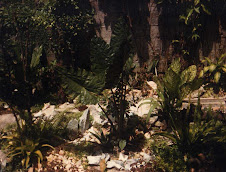
plantation, in one of my fiberglass rectangular ones to see what happens. This reminds
in terms of edible gardening for the tropics, perhaps it would be more pragmatic to plant tubers of all kinds instead of just herbs, lettuce, tomatoes and such. To do something original, swapping this for that, bartering among the gardeners should be the goal. I have so many lemons, capsicum that often I have to give some away, unable to use them. If planting is done with a purpose, many people will benefit, the hungry ones and the not so....

To finish with some thought provoking information... The Chinese are moving in a direction that will certainly surpass the USA in environmental destruction. In thirty
years they have destroyed as much as this country in a hundred and fifty. The Meckong River is one of their victims, along with other countries sharing it and building dams to the left and right reducing the amount of flow reaching Vietnam.
This in turn will eliminate sediment/nutrition and voila,,,a two billion dollar fishing
industry feeding the surrounding population gone....

China again is into the nuclear reactors fever...To reduce the GLOBAL WARMING,
believe or not.. This are the people that make toys with lead, poison in tooth paste,
killing chemicals in milk, will construct a HUGE river to bring water to desert areas.
And so long and so forth. This country is certainly going to screw up the WORLD, particularly ASIA.

India, is moving in the same direction, destroying the environment will reach a similar amount of inhabitants as China, in 2025. If these two countries follow the USA consumption models: cars, private houses, highways and malls it will be interesting to speculate as to how will they feed those rabbit like propagating people in one hand,
and the most significant: how do you built water treatment plants for sewage for such amount of people? Who will pay for it? Without clean water there is no possibility of any kind of life. With or without quality.

Dubai, the fools from this little piece of hell hole are the idiot CHAMPIONS of the world after my compatriots of Puerco Rico. How do take water up to the highest building of the WORLD? Imagine the cost of a gallon of water in that desert, mostly
concrete and asphalt? Burning fossil fuels 24/7 to keep electricity running to keep
those concrete buildings cool day and night for ever and ever. Is there something more
stupid on earth? What about those sinking islands in the shape of hated PALMS?
Who is going to buy these houses sinking in the ocean? How much will the be the cost
of the maintenance? Where do you go for fun the sand dunes or the malls? Perhaps
ice skating under roof. One interesting finance number is the one hundred billion
bucks, this foolish sheiks owe. Good luck to them...

The sheiks will have some difficulty to pay those real estate loans, however who cares?
The worst scenario would be a bankrupt country, nothing new if you think of Haiti.
However there are similarities between Dubai and the cultures that built pyramids
Mexicans/Egyptians. All those silly, useless, unnecessary buildings in that country will
be a monument not to inventive, but to stupidity and arrogance. Just for the afterlife.
Sorry for the shooting. Time to go....

From the Editors

The information presented
is taken from the NY Times,
BBC, RTV. ES
the rest is
my world known humble
opinion.
Nothing is fiction

miércoles, 13 de enero de 2010

CARL LINNAEUS SUCCESS IN GARDENING

A COUPLE of days ago I reviewed a book that some followers of the blog may enjoy.
I decided to present these excerpts for the hell of it. Also for a simple reason, I have
always stressed the need to identify whatever I plant or write about when possible. Some of the names may be/not be pertinent, but if you are into research, find out.
Or get the book: The Brother Gardeners, by Andrea Wulf.

In the summer of 1736, as Peter Collinson was attempting to placate John Bartram, and Philip Miller was working on a new edition of his Dictionary,
a young Swedish botanist thought it necessary to travel from the Netherlands to England to meet all the important gardeners and botanists.
Not yet thirty years old, Carl Linnaeus was already celebrated by botanists in Holland, who he claimed, "sought him as a small oracle".

Such self promotion was a constant feature of Linnaeus's personality. He was conceited and arrogant, calling himself the "prince of botanists" and
insisting that he could achieve more in nine months than the best of his colleagues in several years. The son of a keen gardener, Linnaeus had been fascinated by plants for as long as he could remember, and he liked to tell the story that his love had been installed by his "mother's milk",
for "whenever he cried.... she [his mother] put a flower in his hand, and
he was quiet immediately".

For the past ten months Linnaeus had worked for the wealthy Anglo-Dutch merchant George Clifford, in Hartekamp near Haarlem. As the director of the Dutch East India Company, Clifford had access to the flora from across the world, and his four hothouses held hundreds of plants from southern Europe, Asia and Africa.


In Puerto Rico is impossible to find a garden installation worthy of merit. The last paragraph is significant because in those years, even with the great difficulties of keeping seeds viable, cut stems and plants alive, through long travels by ship, there were hundreds of plants available.
In this pathetic isle in the tropics, I bet dollars to doughnuts, no nursery has more
than thirty if that. When there are thousands! I clarify that plants here equals species.

Success? When I think about all the written words, the vegetation propagated, planted, identified, those that are still alive and those that passed away, a great feeling
of joy flows through the spirit. I may seem arrogant, feel like "small oracle" for the irritation of foes. But will go further...When I was working with the scam artists and environmental criminals of the Luis Munhoz Marin Foundation and Parque Donha Ines, I did in a couple of years, what the incompetent, illiterate fools doing the grounds keeping never did in ten! I propagated hundreds of plants, tens of species
in that shitty hell hole full of thieves, out of my pocket.

After all these times I believe that something here and there, may have been of use to you far away reader, perhaps even a laugh, regarding gardening, landscaping maintenance/installation, environmental, ecological, political, migratory issues, music, movies, books and so forth. I confess that it has been a pleasure, even with the flimsy criticism of one shitty architect who has not built/design a side walk/gutter, Climent, his last name, and the King of the agronomists JERKS: Edwin Gonzalez Bauza.

If we are to "save" the environment, lets do it for us, now. Without water, air, food
and a roof, what kind of life is there?

The reading of this book has helped me to put some things in perspective. My gardening practice, is all I care for. Not necessarily to maintain my bragging rights, but to enjoy the flora/fauna around the house, since outside these boundaries, what is
there, what I have shown in pictures, what I see stinks...

That makes the feeling of success, of sharing it with others more satisfying.Time to go....


lunes, 11 de enero de 2010

BOOK REVIEW GARDENING IN THE DIRT NEWS


The Brother Gardeners
BOTANY, EMPIRE
AND
THE BIRTH OF AN OBSESSION
BY
Andrea Wulf
Alfred A. Knoff , New York 2009

On an early summer's day 1n 1716, Thomas Fairchild went into his Hoxton garden, closed the door of his potting shed and set in motion a chain of events so momentous that in time no gardener would ever think about plants in the same way again. At the same time, it let Fairchild, a devout Christian, to live in fear of God's wrath for the rest of his life.

That is the first paragraph of this wonderful book, with excellent illustrations, bibliography and references. If you are a native from one of those countries originally under the British Empire, even if you are not, you will have great reading pleasure.

Another requirement to enjoy it, is some interest in history, botany, botanical names,
plant collecting and so forth...Evidently, England has done a lot for gardening. This activity is what I do and enjoy more in life. If you want to go beyond the surface, your
intellect will appreciate it.


SOME FANS may wonder how much time I spend in the garden. Well, I sweep daily,

sometimes twice a day, daily, monitor for insects, watch everything carefully to
see any odd events, with Diva, the Cyperus lover dog, this is alternated with ball games, throw and fetch kind. Even in her senior years, Diva keeps that joy and quick
energy, present in many happy children, when the time to play comes. Determine which garden activity has to be done right away or later.. Out of the seven days I spent, twenty hours between this and that on the premises. A little less if it rains...

The eradication of Bejuco de puerco and Wedelia trilobata in the south garden, is almost complete and the area looks more tidy. It was done in three stages to avoid that anxiety that once in a while arrives suddenly when getting into tedious, unpleasant tasks. This is one of them. Getting rid of vines behaving like grass with rhizomes/stolons, a real pain.

Other events more or less interesting were traditional relocation from one bed
to a better one, pot to bed or vice versa.. A Bauhinia blakeana has taken the place,
pot and corner of the now in Guerrilla Territory, Thevetia peruviana. By the way
I went to check it finding it on the ground. It was too heavy on top, plus the ground somewhat saturated..Got rid of some branches, looking sharp, and is now with the Tamarindus indica close by, the Maguey and the DK, in the chosen triangular space.

The forgotten Crotton slow as nothing else is now in a new spot, 3 species of Tradescantias were propagated to substitute the eradicated ones, the Bauhinia
tomentosa is now in a new pot looking refreshed. Clitoria ternatea, Merremia
quinquefolia were planted from seeds to increase the vegetation volume in the metal fence in the north garden.

Some white flies were discovered in the Murrayas paniculatas. It is a problem that
comes and goes. They were sprayed and that was that. In general there are not many
pests in the garden. The amount of lizards, birds, spiders take care of them.. Once in
a while snails come, so do beetles, but it is not a great concern because the damage
is mostly aesthetic.

Finally, collected seeds from the Cosmos sulphereous to spread them by the Guerrilla Territory. And that is that, time to go....


domingo, 10 de enero de 2010

AFRICANS IN ITALY MIGRATION ISSUES

IT WAS recently on BBC. Some black fellows from that continent being whipped by the police native forces. Apparently some bored Italians, used them as target practice. The victims retaliated unwisely, destroying
private property. Lucky them Africans when one think of it. Had it been 5o years ago in USA, in the south or any other region/area where they are still not welcome, the story would have been a little different for the blacks....probably hanging from trees.

Since no one invited them, all are illegal, that is the price to pay. What I do not comprehend is the brouhaha about their infra humane housing/living conditions. They are exactly the same, never worst, as their countries of origin, except for the cold, snow, rain of the season.

SPAIN. The news presented stories of Spain nationals, who went on holidays, finding Romanians and Nigerians have taken residence with all their belongings, in their apartments at their return. Up till recently it was almost impossible to get rid of tenants unwilling to pay rent. The procedures in court would take a year or longer. Now all has
changed with a new law expediting both situations in thirty days. Pretty
similar as what takes place in NY City.

The shooting and beating up of migrants also takes place here. Prostitutes or sex workers in Spain are over 95% immigrants from Romania, Nigeria, South, Central America and the Caribbean. They are
exposed since they spend most of their time in the streets waiting for
customers.

MEXICO. From my perspective, in USA the situation is radically different. If you review the relationship between Mexico and USA, you will find that one third of the territory of the latter, was stolen/taken in that silly war moons ago. Therefore, MEXICANS are not entering a territory/country where they are not WELCOME. They are entering legally or illegally to the lands stolen from their ancestors in an
unfair, unnecessary war. That makes their immigration very peculiar since there seems that no other countries share this situation.

Immigration is consequence of over population, destruction of the environment and inept governments. Look at the countries providing
all these mostly ugly, welcome/unwelcome migrants. They are in four continents. Democracies and dictatorships alike. It is getting worse and there is no room for change.

In the case of CHINA, the immigration is from country to city to work for peanuts. It seems that the capacity to exploit others has no ethnic, cultural, social boundaries. The destruction of the environment, building 24/7 in China and some other countries in the region will have dire consequences soon. With the wild changes in climatic conditions, it is going to be hard to cultivate enough rice, to have one cup a day.

Migration is a rule in nature. Whales, birds, turtles to name a few travel in season to search for warmth, food, rest. The earth used to provide for
all, before men destroyed their habitats in every conceivable way.

Now the problem of people procreating as rabbits traveling, entering illegally to countries that are getting fed up with the situation has reached the limits. Some jerks with blindfolds will attribute the REJECTION of ugly people to RACISM. But think for a moment of countries like SPAIN,
ITALY, TURKEY. They are not dark if you compare, many are blond with blue eyes. They were certainly not welcome in Germany, Switzerland during the sixties, was that also racism? I believe that one do not want strangers around, ugly or not around, even if they speak the same language. Puerco Rico is no different. But I will not get into that.

This is getting too long. Is time to go. But a final word. I was a migrant
in USA for half my life, lived for 18 months in Deutschland, during my
time as a freedom fighter in German discos in the 70's. What I think
is result of what I have lived. And with clear sight, everything we do
is possible thanks to air, water, food and a roof. Life will not remain
if the destruction continues for anyone, flora or fauna.

I could stay in my garden admiring my Frangipanis, writing only about that, or the beauty of the Spindalis, hummingbirds,or the singing of the always high in some perch mockingbird that is on his performance while
I write these lines, but sorry, it does not suffice. Now I leave.